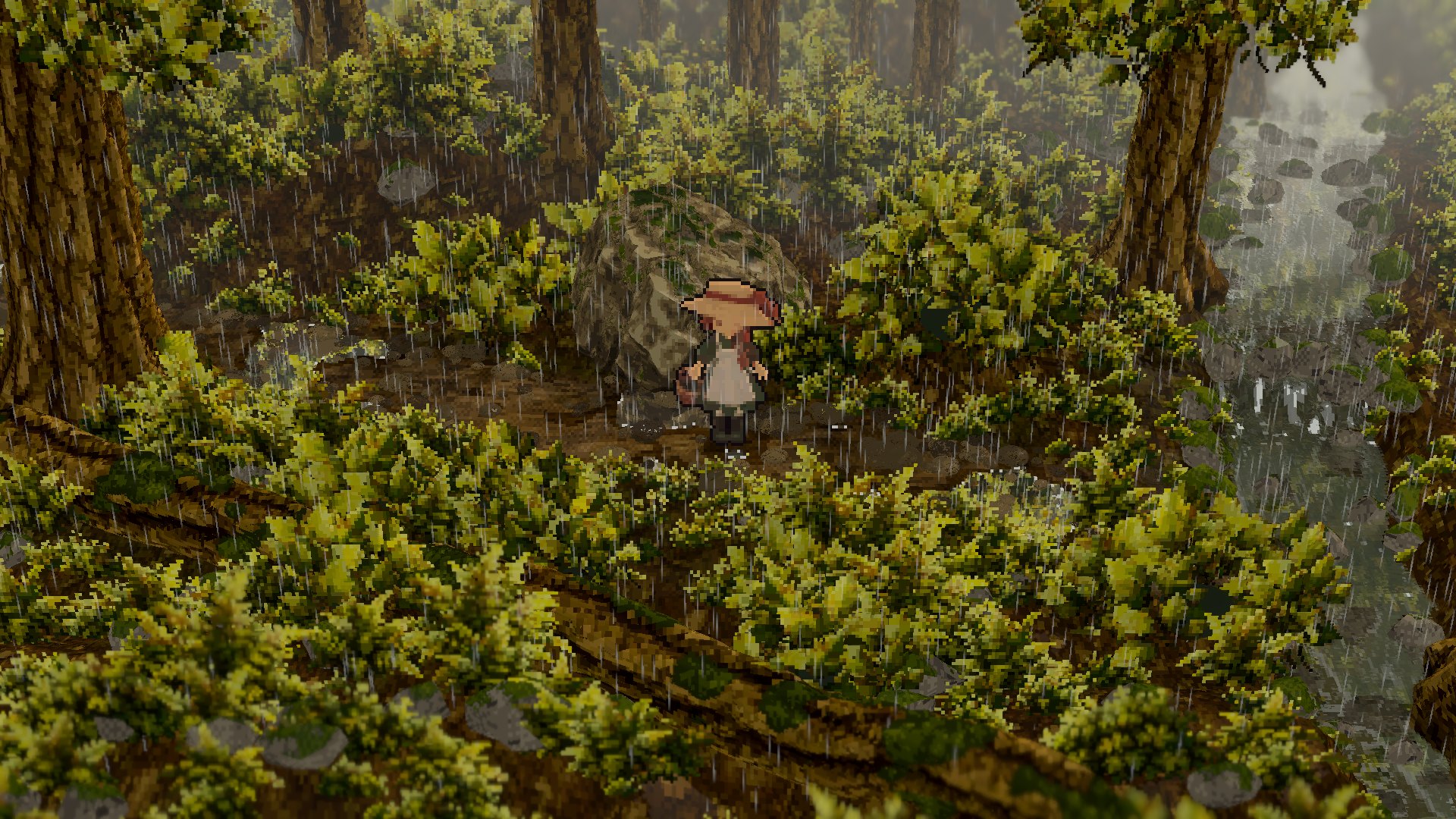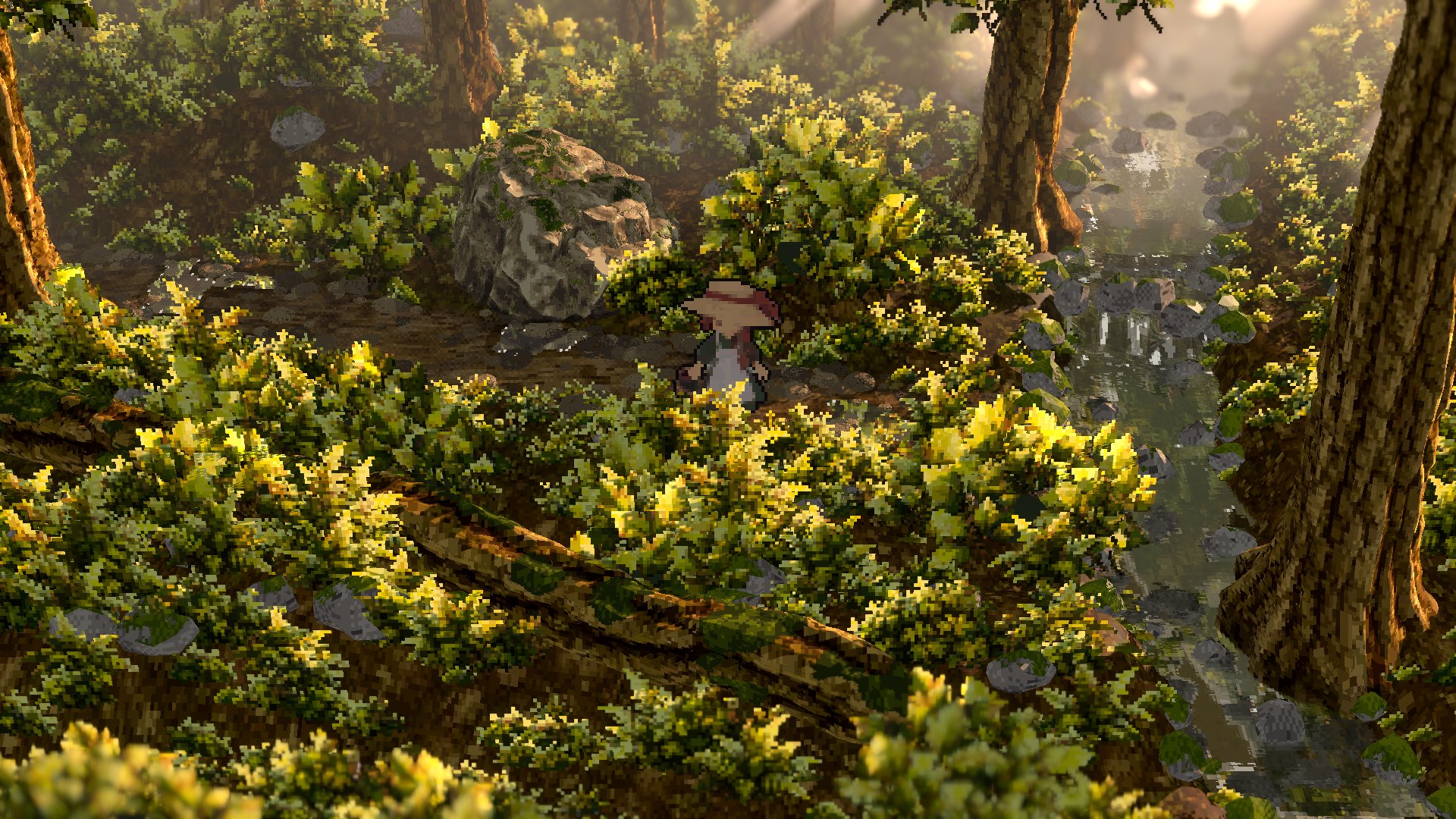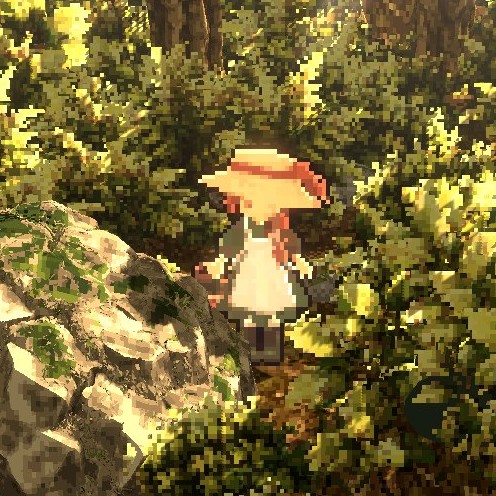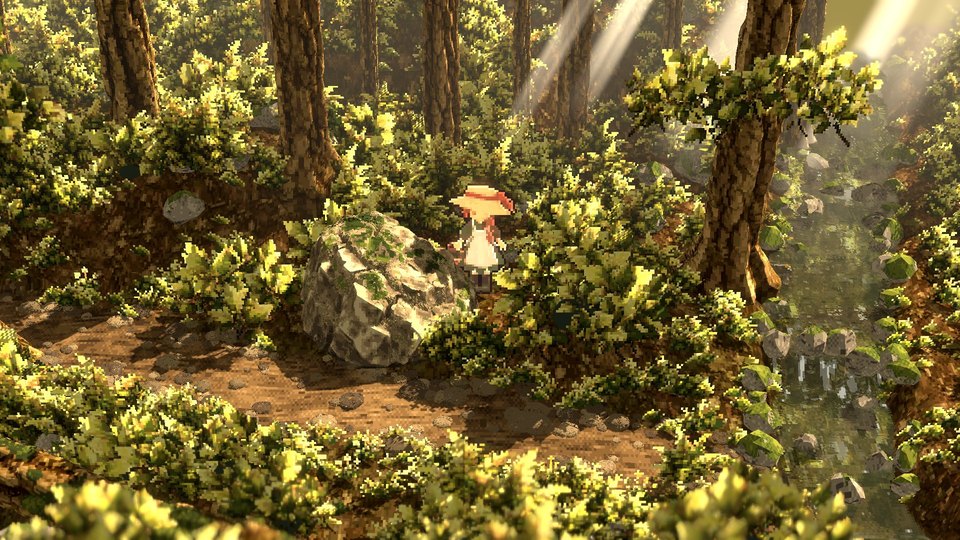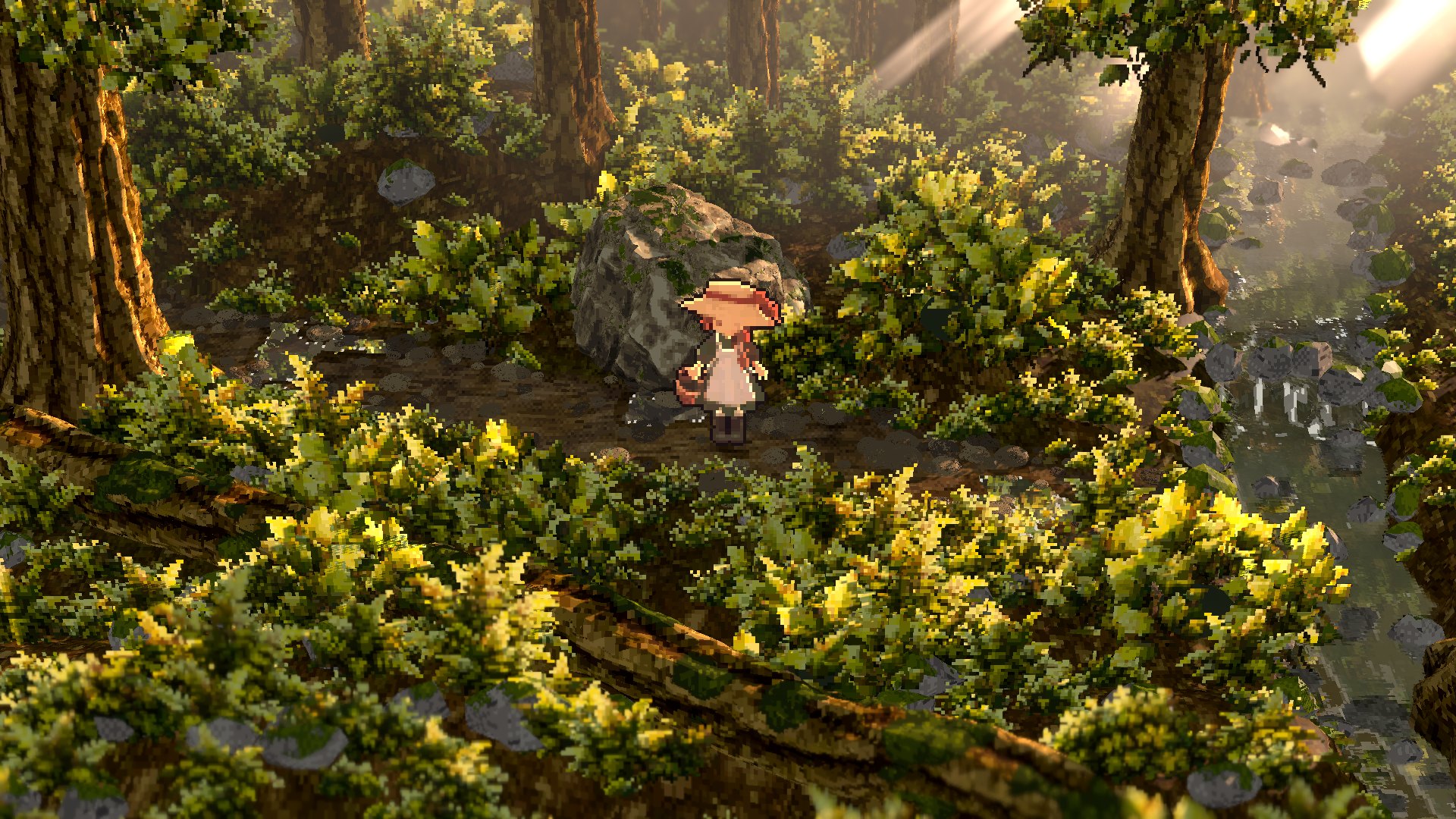
In-game screenshot: a girl in a straw hat stands on a damp forest path beside a mossy boulder, morning light falling through the trees.

Studio BomulBang presents

Glimmer Hollow

A quiet collecting game about finding small things in a gentle world.

In development · PC · Steam page coming soon · Follow on itch.io

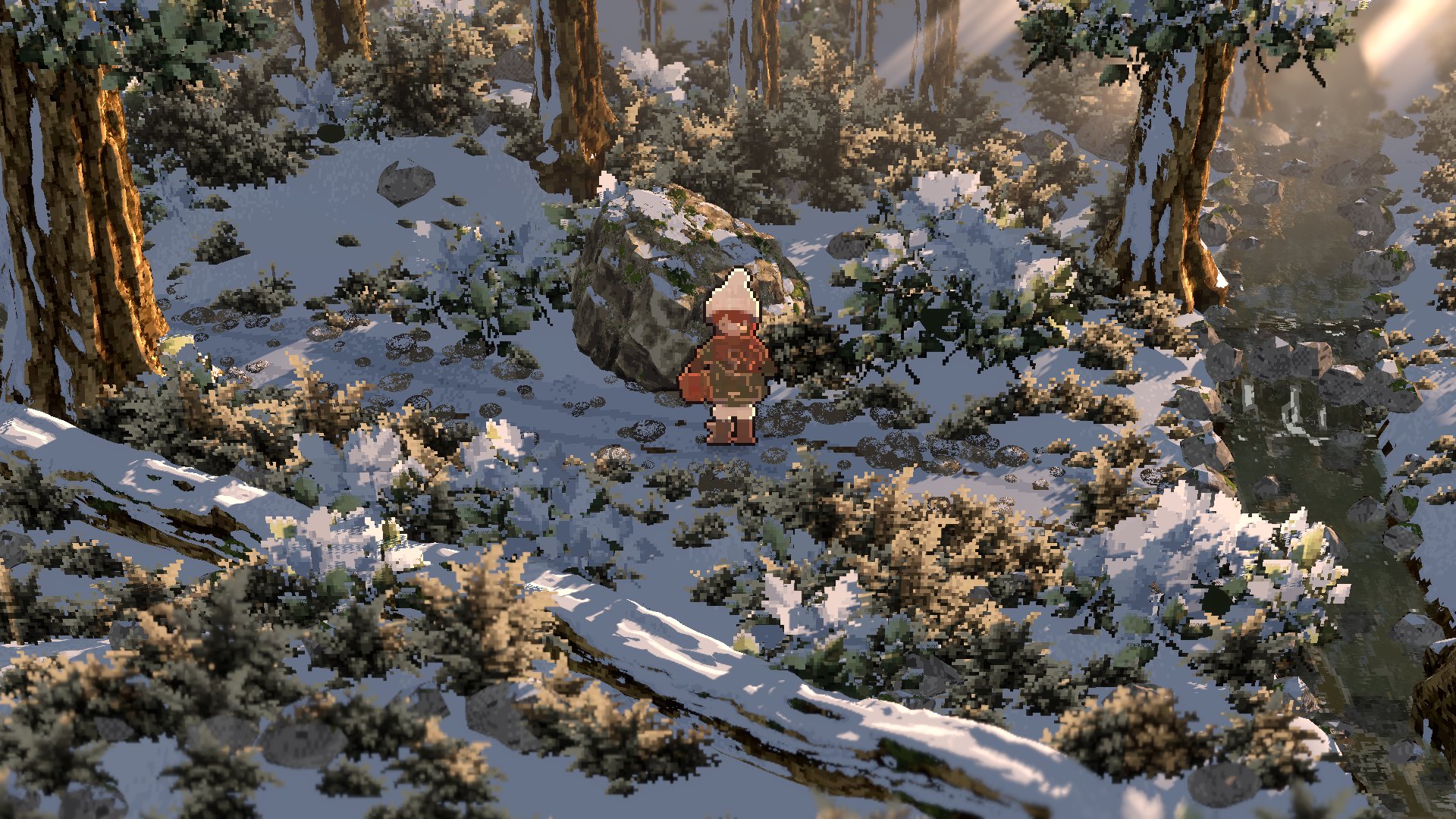
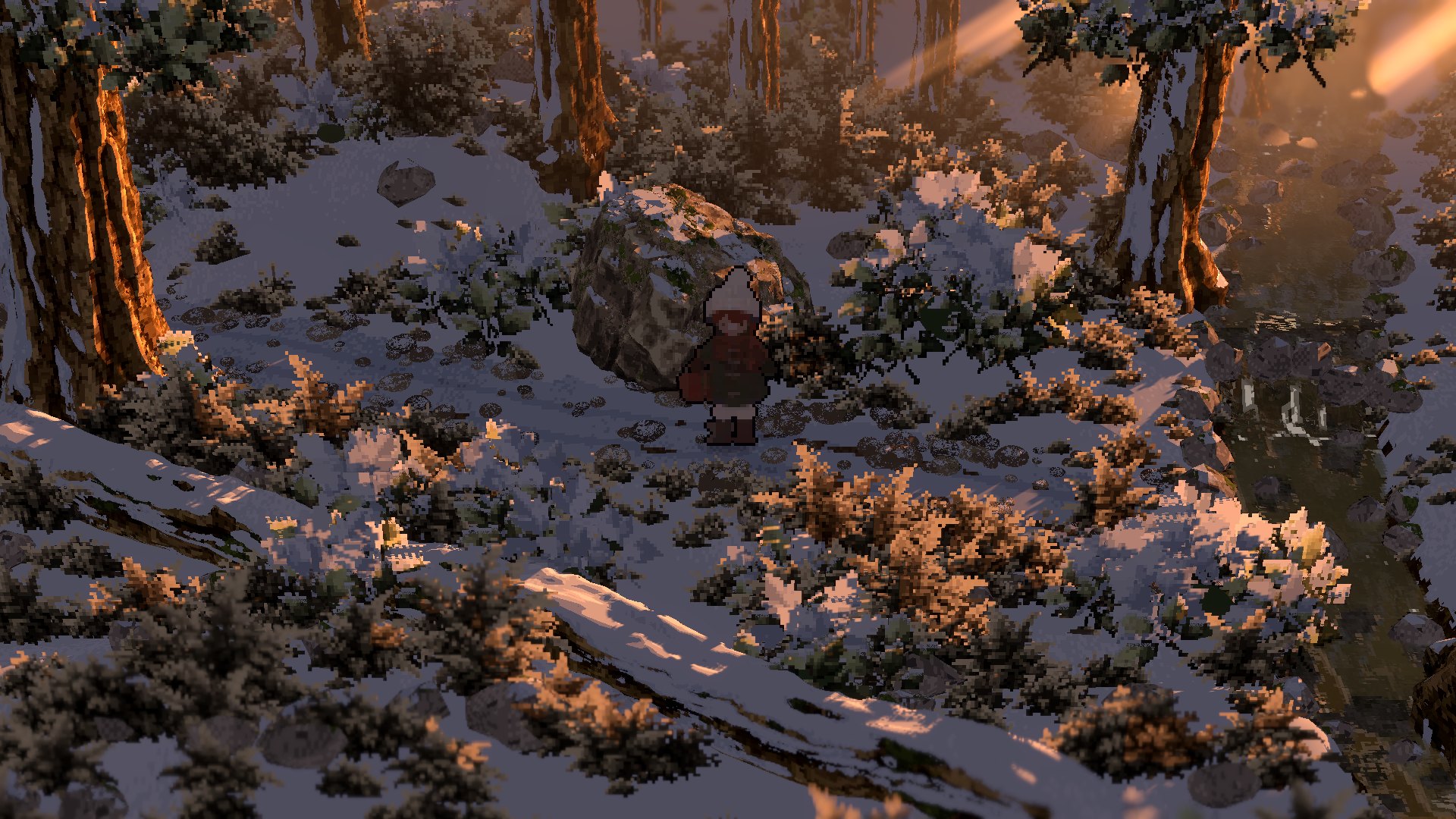
In-engine screenshot (Godot 4), work in progress

The game

Walk out, look closely, bring it home.

An old naturalist leaves you a cabin at the edge of a forest, a sleepy cat, and a letter. Their field journal is full of things they saw, and a few things they never found.

You pack a backpack, choose a companion, and walk out into a connected world. You collect minerals, flowers, mushrooms, insects, fish, fossils, recipes and old curios, about four hundred entries in all. Each one is found by hand and written into the same journal the old owner started.

There is no shop to sell to and nothing to grind. You collect because finding things is the fun part.

Collect by hand

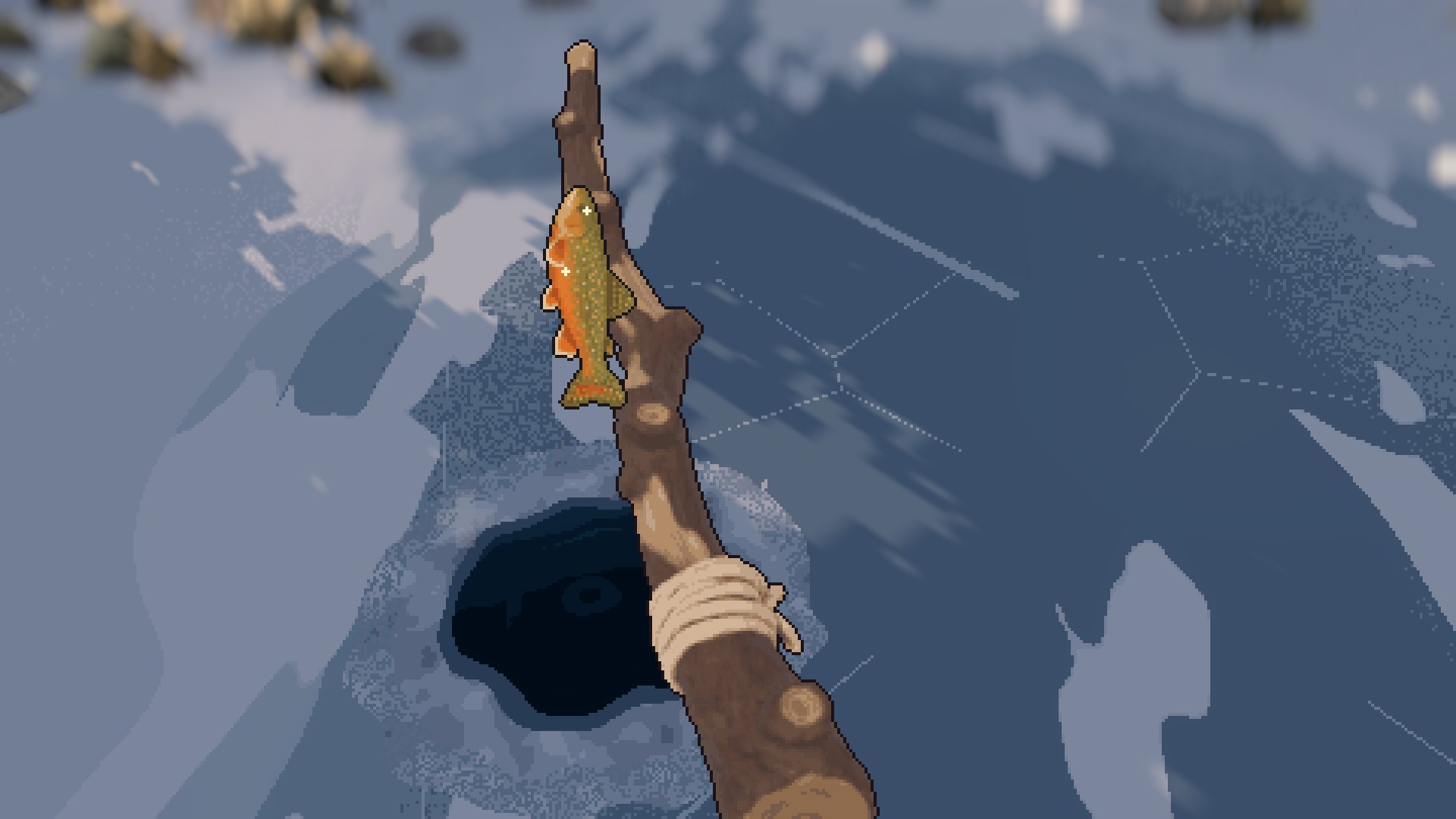
Rare finds switch to a close first-person view right where you stand. Chip a crystal free, lift a flower by its roots, reel a fish in and let it go. Each kind of find has its own small, tactile motion. The first one, ice fishing, is shown below.
A shared field journal

Entries fill in slowly, from a trace to a glimpse to a specimen in hand. Specimens go into drawer cabinets you can open, and favourites go on shelves you arrange yourself.

A world that changes

A day passes in about half an hour, and weather leaves marks behind: wet paths the morning after rain, snow that stays. Long seasons turn slowly, and some things only appear at certain times.

Nothing is harmed

Animals are watched through a spyglass, never caught. Insects and fish are released. Food comes from the forest, the garden, and neighbours who share.

Glimmer, a guide made of light

A faint light runs under the valley. A small creature formed from it knew the old owner, and it quietly points the way.

Tools open the map

Progress comes from tools you make yourself at the forge, guided by clues from old maps, notes and neighbours. You never unlock areas by filling a percentage.

In motion

One forest, live weather

A single take from the engine. Nothing is cut or composited: the same scene moves from morning to noon, clouds over, rains, dries out the next morning, turns to evening, and then snows. Snow settles on every surface by rule, and the character changes into winter clothes on her own.

Morning · noon · overcast · rain · after rain · evening · snowfall · after snow, recorded in Godot's Movie Maker mode

A first collecting moment

Ice fishing on a frozen pond. You walk up to the hole, and the view drops into first person: wait for a bite, pull, look at what you caught, and let it go. Recorded in-engine; this is a look prototype, not finished gameplay.

Ice fishing · third person to first person and back
Snowfall in the hollow · three layers of falling snow

Screenshots

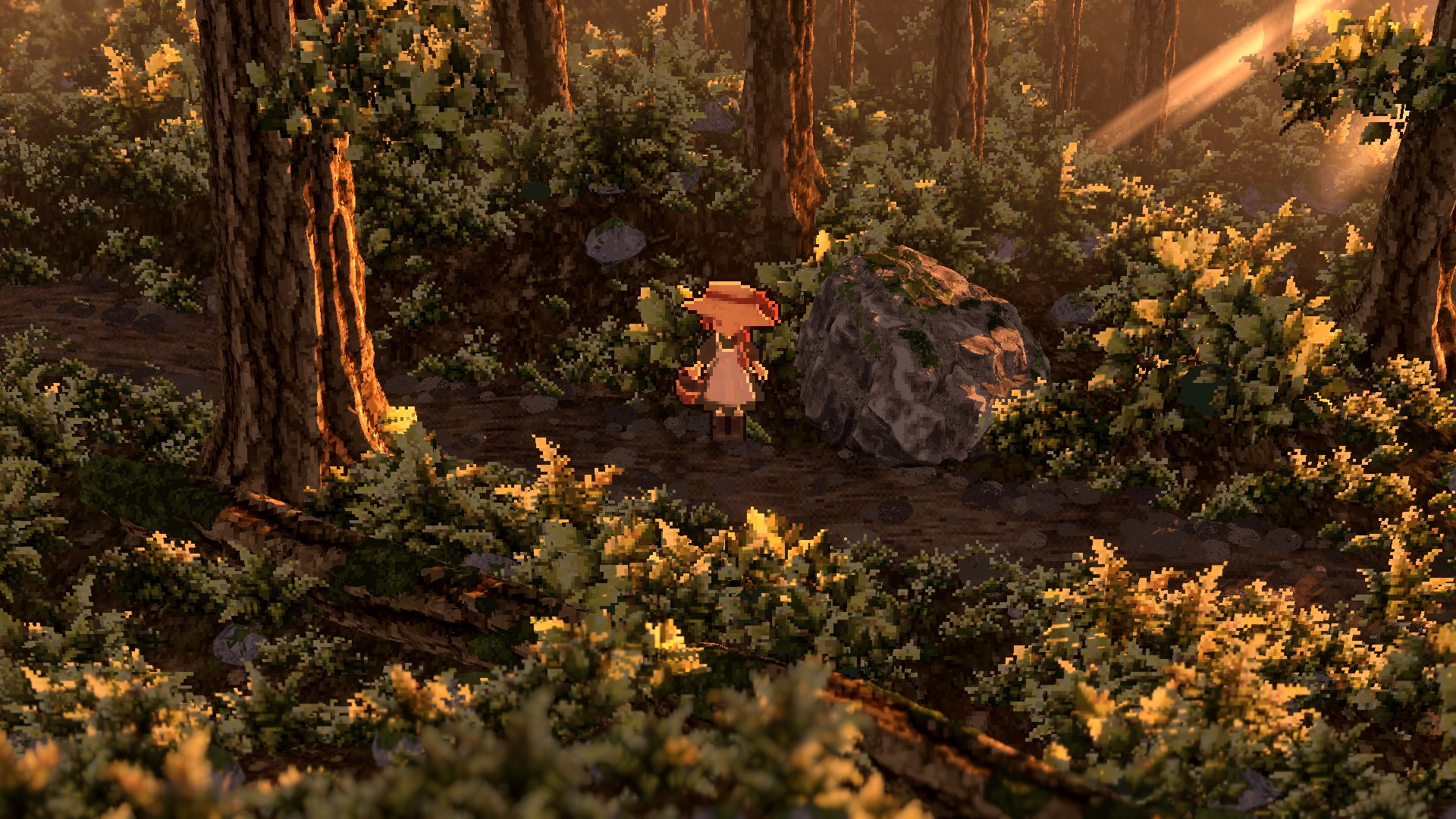
Two places so far, at different hours

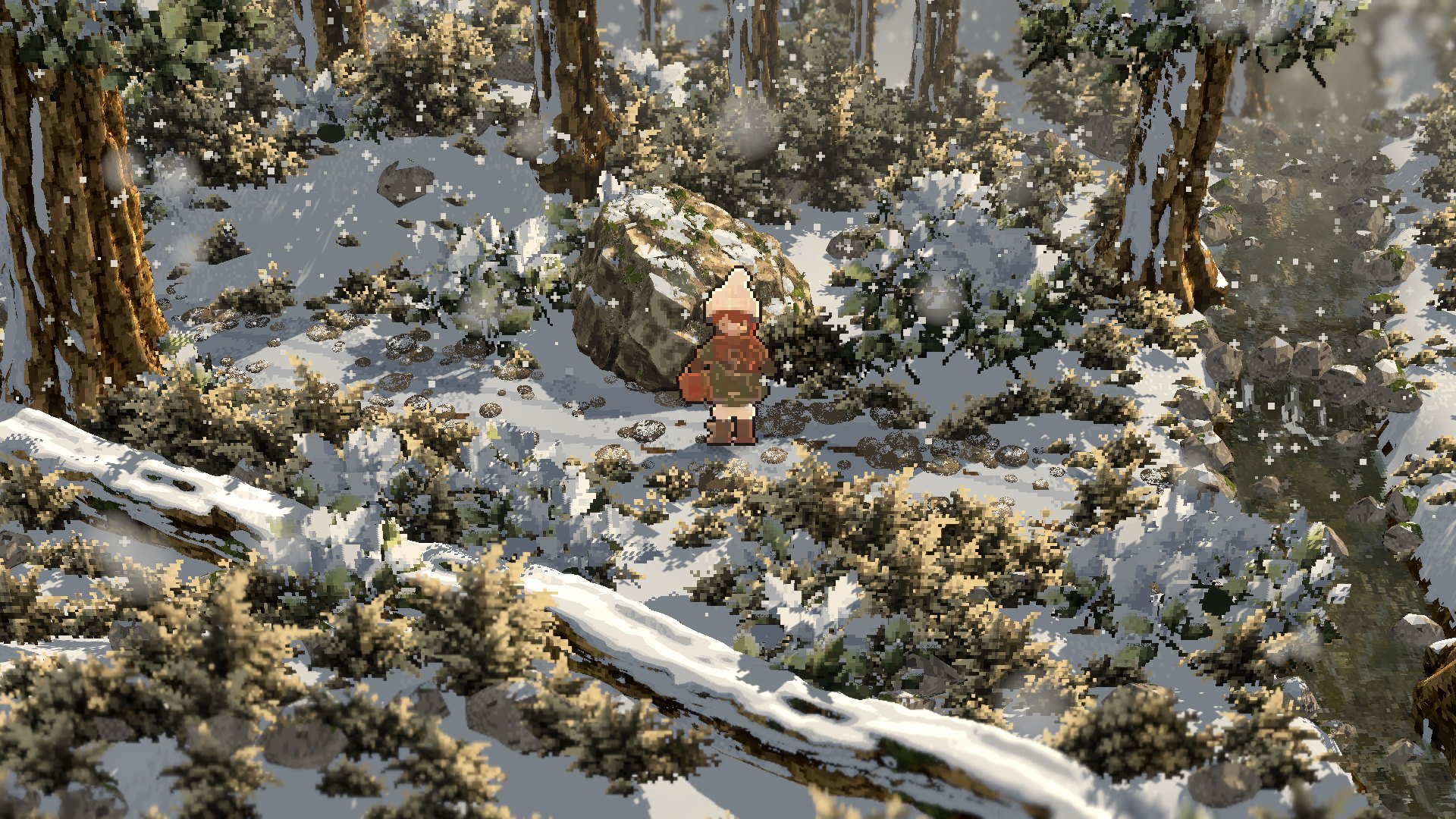
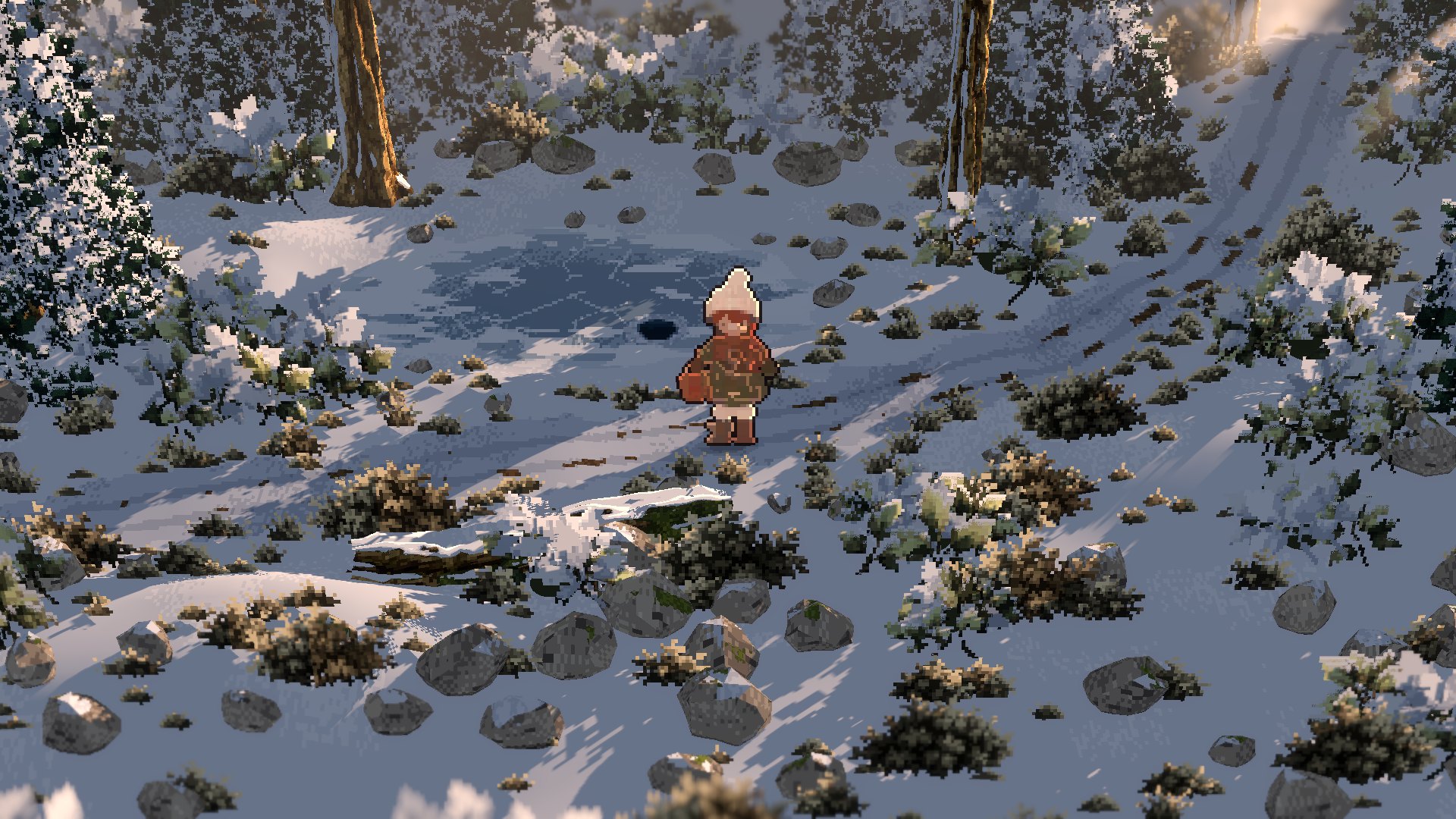
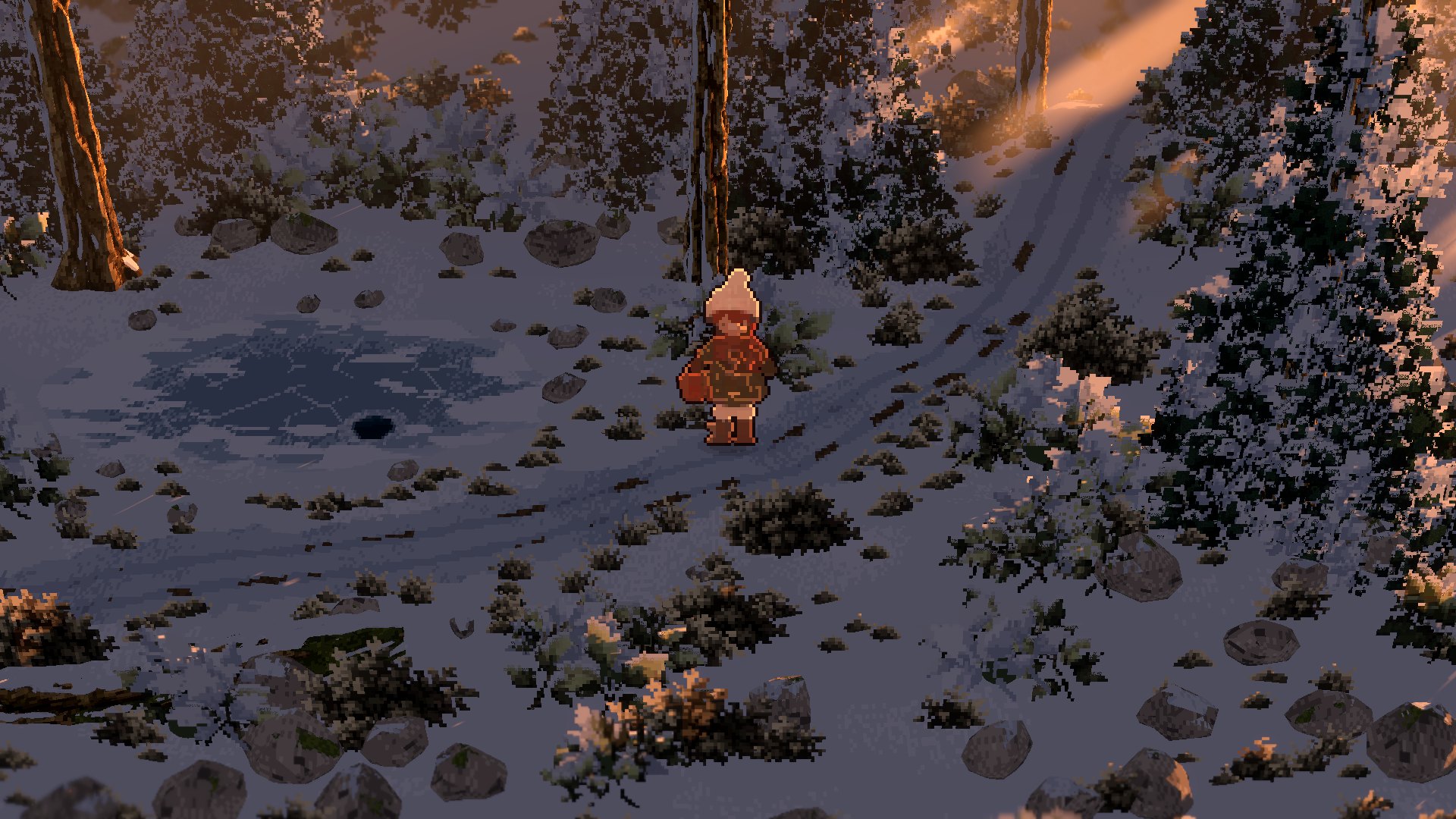
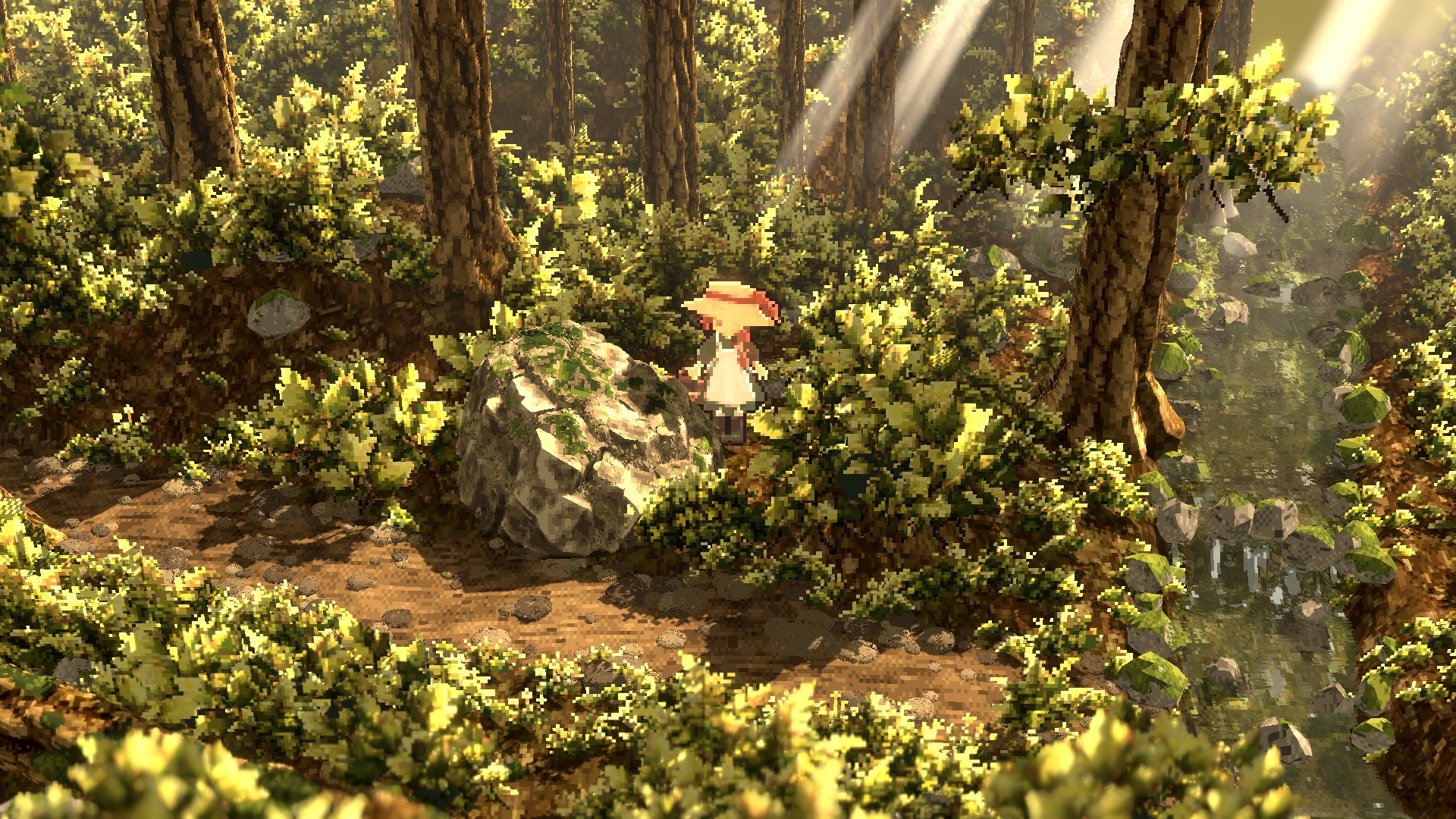
All images are captured directly from the game in Godot 4. There is no paintover or concept art. Time of day and weather are live systems: when it snows, the same rules cover the ground, plants, trees and rocks, and the character changes into winter clothes.

The forest path

The same forest, after snow

The snowy hollow

Making of

From a 3D model to a pixel sprite

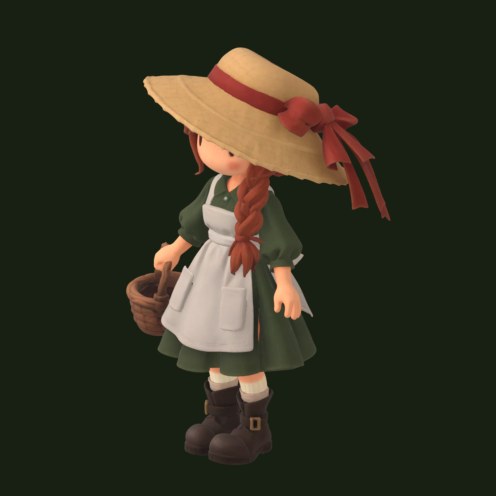
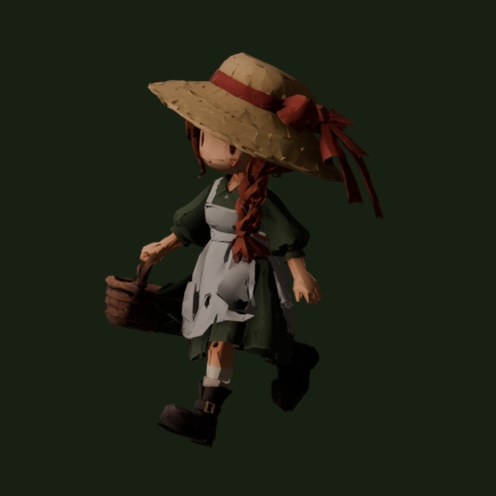
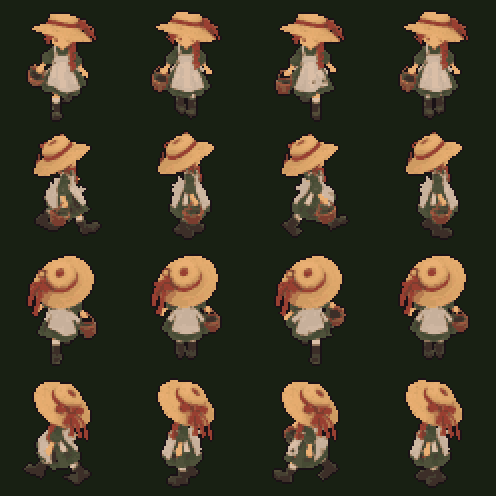
Characters are built once in 3D, then turned into pixel art by code. The rig, camera, palette and pixel grid are fixed in scripts, so every direction and every frame comes out as the same character. When something looks wrong we change the rule and re-run it, instead of painting over the output.

3D model of the main character: straw hat with a red ribbon, braids, green dress, white apron and a basket.
1 · ModelAn image-to-3D model (TRELLIS.2 on a cloud GPU), cleaned and reduced in Blender.
The same model rigged and posed mid-step.
2 · Rig and poseAuto-rigged, then walk and idle poses are set by script in headless Blender.
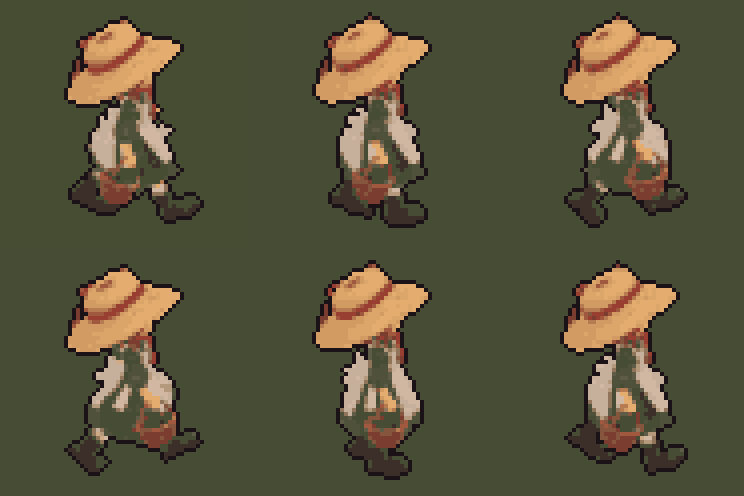
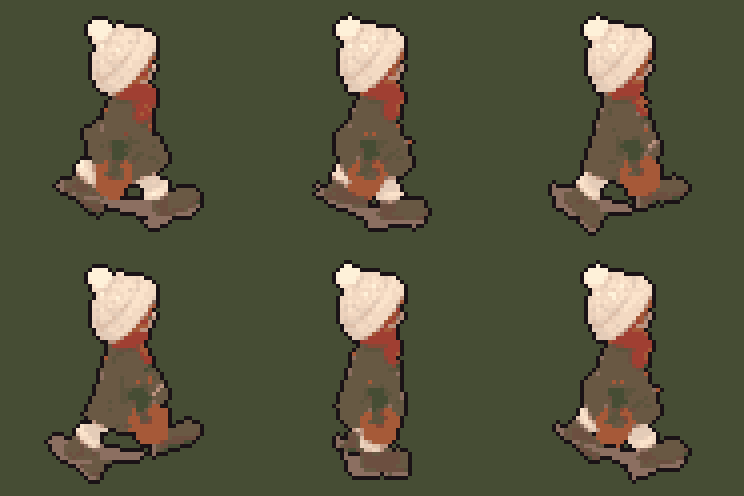
Sprite sheet: walk frames of the character in four directions.
3 · Sprite sheetRendered in four directions and reduced to a 48-pixel grid with a fixed palette and outline rule.
The pixel character standing on the forest path in game, beside a mossy boulder.
4 · In gameLit by the scene's sun and leaf shade, with a rim light on the side facing the sun.

How the forest path grew

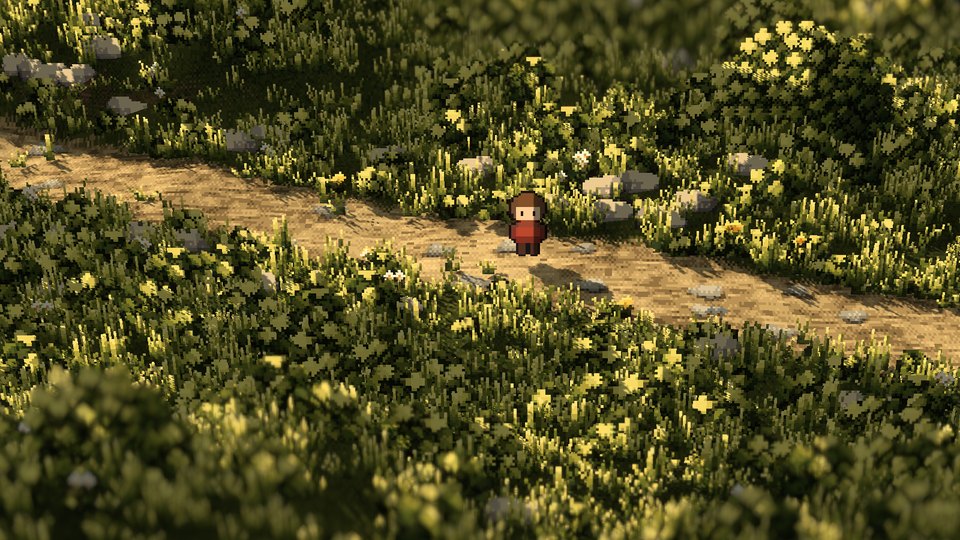
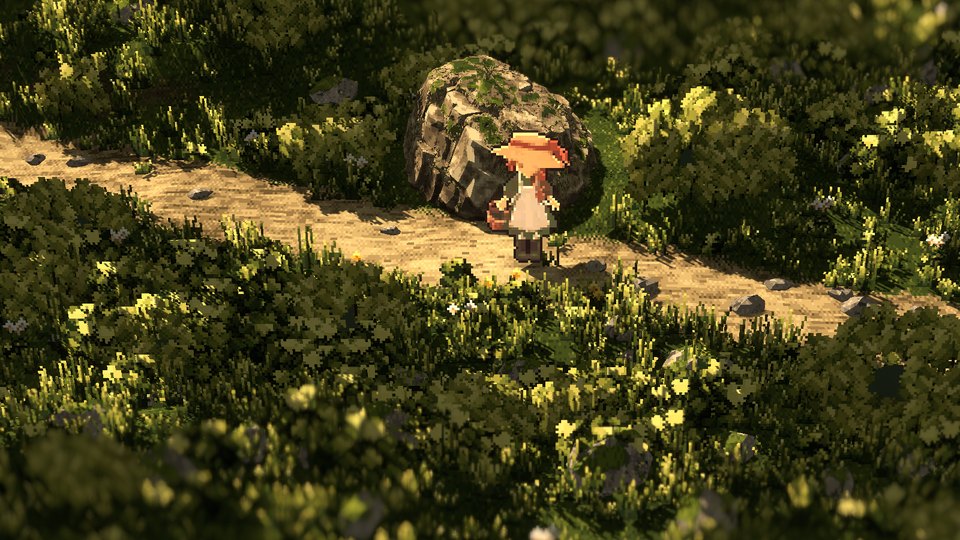
The same corner of the first scene at three points in development. Every frame is a straight capture from the engine.

Early version: a flat path through grass and bushes, with a simple placeholder character.
First passPixel ground cover and light on a flat path, with a placeholder character.
Second version: the real character and a mossy boulder on the same path.
Character pipeline inThe real character, a boulder made with the same 3D-to-pixel approach.
Current version: tall trees, light shafts, a muddy path and a stream with a small cascade.
NowTrees and bark, light shafts, a textured forest floor, mud, and a stream.

Under the hood

Counted from the project repository.

Engine
Godot 4.7, GDScript
Game code
14 scripts, about 3,100 lines
Shaders
11 custom pixel shaders, about 1,400 lines: ground, bark, rock, foliage cards, water, snow and ice
Asset pipeline
26 Python and Blender scripts, about 3,700 lines
3D sources
12 models generated on a cloud GPU at roughly $0.10 each, rigging at about $0.02
Design record
58 logged decisions, including the attempts we dropped and why

Development

Devlog

Glimmer Hollow is in early development. We set the visual target first, then the design, and the vertical slice comes next. Milestones are listed oldest first.

Pixel-art walk cycle of the main character in summer clothes.
Pixel-art walk cycle of the main character in winter clothes.

Walk cycles from the character pipeline: summer and winter clothes

  1. Milestone 01

    Visual prototype in Godot

    The first walkable forest path. The character goes from concept to 3D model to rig to pixel sprite, and responds to sun and leaf shade.

  2. Milestone 02

    Core design settled

    Home and expeditions, one gentle stamina bar, first-person collecting moments, the field journal and cabinets, scattered neighbours, and the story of the old naturalist.

  3. Milestone 03

    The forest after rain

    New trees and bark, dappled sunlight, a muddy path, puddles that reflect the canopy, a textured forest floor and a stream that drops over a step of stones. Clear, overcast, rain and after-rain share one lighting setup.

  4. Milestone 04

    A second place: the snowy hollow

    Conifers, a frozen pond and a trodden path. Snow settles on everything by rule, falls in three depth layers, and the character changes into winter clothes.

  5. Milestone 05 · latest

    First collecting moment: ice fishing

    A hole in the frozen pond, a branch rod, and a brook trout. The camera drops into first person for the bite, the pull and the release.

Roadmap

Where it's heading

  1. Visual targetPixel-art 3D look, light and weather, two places
  2. First collecting momentIce fishing in first person, as a look prototype
  3. 2026 Q4Vertical sliceOne full loop: walk out, find, collect by hand, record, display
  4. 2027 H1Steam pageStore page, first trailer, wishlists open
  5. 2027 H2Public demoA playable demo, for example during Steam Next Fest
  6. LaterRelease on SteamPC first, with mobile to follow

Studio

How we build

Studio BomulBang is an independent one-person studio based in South Korea, founded in 2026 and run by minbang930. Glimmer Hollow is our first game, built in Godot.

We use Claude Code throughout our development workflow, from gameplay programming and debugging to asset creation. In practice, I set the direction and approve results; Claude Code writes the scenes, scripts, shaders and pipeline tools, then runs the game headless, captures screenshots, compares them with our reference images and iterates until they match. Every decision, including the failed attempts, is written down in the project docs so the next session picks up where the last one stopped.

Art follows strict rules written as code: a fixed pixel grid, palette constraints, and generators we tune and re-run rather than hand-fixing their output. That keeps the look consistent as the world grows.

Contact

Say hello

Press, partnerships, or just a kind word.

contact@bomulbang.site

Steam: coming soon · itch.io · GitHub